Posted on Thursday, March 31, 2005What happens to my American debts if I go bankrupt in Canada?As a trustee in bankruptcy based in Windsor, I am frequently asked "what happens to my U.S. credit cards when I go bankrupt"?U.S. creditors are not bound by the bankruptcy you file in Canada; they can continue to pursue you in the U.S. for any debts you incurred in the U.S.. However, if you are living and working in Canada, you are protected by the stay of proceedings in Canada - this means that U.S. creditors cannot pursue you for your debt in Canada. They can't sue you or garnishee your Canadian wages. The situation becomes more complicated if you work in the U.S. Canadian bankruptcy protection does not protect your U.S. wages from the creditors in the U.S. If you live in Canada but have U.S. income and U.S. debts, it may be wise to consult an American bankruptcy attorney. Bankruptcy rules are complicated and no two situations are exactly the same, so if you are having financial trouble please e-mail me or call our nearest office and we will walk you through your options. Posted by Rebecca Martyn, CGA, CIRP, Trustee @ 9:17 AM
Posted on Wednesday, March 23, 2005How Long Does a Bankruptcy Stay on my Credit Report?I am often asked how long a bankruptcy or a consumer proposal remains on a credit report.In Canada there are two large credit reporting agencies, or credit bureaus, Equifax and Trans Union, and they each report bankruptcies and proposals differently. On Equifax's web site they state that "A bankruptcy automatically purges six (6) years from the date of discharge in the case of a single bankruptcy. If the consumer declares several bankruptcies, the system will keep each bankruptcy for fourteen (14) years from the date of each discharge. All accounts included in a bankruptcy remain on file indicating "included in bankruptcy" and will purge six (6) years from the date of last activity. A consumer proposal is automatically purged from your credit report three years after the last payment is made. On Trans Union's web site they state that information is maintained on your credit report "for as long as your information is relevant to an organization making a decision about an application you have supplied... However, provincial credit reporting legislation outlines maximum reporting lengths for information that is negative. Therefore, TransUnion will not maintain negative information on your credit file longer than what is permitted by provincial credit reporting legislation." In Ontario, credit reporting is governed by the Consumer Reporting Act which states, in subsection 9 (3) (e), that a consumer reporting agency shall not include in a consumer report "information as to the bankruptcy of the consumer after seven years from the date of the discharge except where the consumer has been bankrupt more than once." In other words, Equifax automatically deletes a first bankruptcy six years after the date of discharge, whereas Trans Union leaves the bankruptcy on your credit report for seven years after the date of your discharge. It is important to note that your credit report is only one element lenders use to decide if they will let you borrow money. They are also interested in your income, job stability, assets, and perhaps co-signers. By saving money and paying your regular monthly bills on time, it is possible to gain access to credit in less than seven years after your bankruptcy has ended. Posted by J. Douglas Hoyes, CA, Trustee @ 11:18 AM
Posted on Wednesday, March 16, 2005Can I keep my house if I go Bankrupt?Today I met with a married couple who own a house, but due to her job loss and his reduced hours at work, they are now unable to service their debts. They used their credit cards to survive while she was off work, and even though she has found another job, they don't earn enough each month to pay all of their credit card bills.Their most pressing question: "If we have to go bankrupt, will we lose our house?" The answer depends on the value of the house, and the amount owing on the mortgage. If there is positive equity in your house, if you go bankrupt, you must either surrender the house to the trustee, or pay the trustee the value of the equity, which is then distributed to your creditors. I advised the couple to get an appraisal on their house so we have accurate numbers to help make this decision. Based on our rough numbers, it appears there is about $10,000 in equity in their house, so bankruptcy may be a problem I suggested that instead of going bankrupt and losing their house, they could try a consumer proposal. If in a bankruptcy the creditors would expect to receive $10,000 for their house, we could offer as a proposal perhaps $15,000, to be paid over a period of 50 months (at $300 per month). The creditors may accept that proposal, since it's more than they would get in a bankruptcy. It's also a good deal for this couple, since they don't lose their house, and they can afford to pay $300 per month. There are other factors to consider before deciding if a proposal is the correct option, so if you or someone you know is in a similar situation, I encourage you to e-mail me and I or one of our associates can meet with you to review your situation and work out a plan that works for you and gives you a fresh start. Posted by J. Douglas Hoyes, CA, Trustee @ 9:10 PM
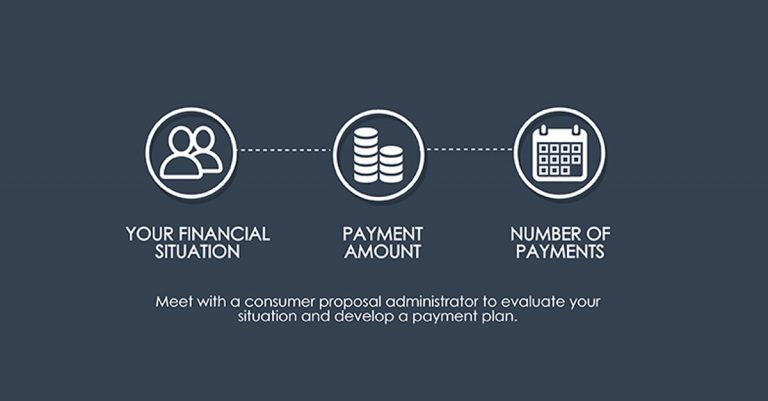
Posted on Saturday, March 12, 2005Proposals - A Bank's PerspectiveThis week I spoke to a representative of one of Canada's large banks. We discussed how they decide whether or not to accept a proposal.A proposal is a negotiated settlement between a debtor and their creditors. Last month we filed over 60 proposals for individuals, so as one of the largest proposal administrators in Ontario, we are always interested in what creditors are looking for in a proposal. The bank's representative confirmed that they evaluate all proposals based on "their merits". That means they review the proposal to ensure that the proceeds of the proposal are greater than what they would receive in a bankruptcy, and that the proposal itself is reasonable. At Hoyes Michalos, before we file a proposal on your behalf, we review with you your budget to determine what payment you can afford each month. We will only submit a proposal if it is affordable for you, and if it is likely to be accepted by your creditors. Feel free to e-mail me if you would like information on how a proposal can be used to deal with debts and avoid bankruptcy. Posted by J. Douglas Hoyes, CA, Trustee @ 6:48 AM
Posted on Wednesday, March 09, 2005American Bankruptcy Reform Bill Set to Pass the Senate - Changes to Force More Americans to File Canadian Style ProposalsThe American Senate is expected to pass the Bankruptcy Abuse Prevention and Consumer Protection Act of 2005 (S.256) within the next two weeks, and President Bush is expected to sign the bill, which represents the most significant changes to the American bankruptcy process in over 25 years.Under this new legislation, all debtors will be subjected to a "means-test" based on income and expense standards devised by the Internal Revenue Service to deal with tax debtors. As an example, if the debtor has $100 per month more in income than the IRS would allow a delinquent taxpayer to keep, they are required to file a 60 month repayment plan under Chapter 11. In the plan the debtor would pay $100 per month for 60 months, or $6,000 to the plan. The creditors would receive the $6,000 over five years, less the costs of administration. Since debtors will probably pay more under the new American system, it is not surprising that the new legislation is strongly backed by the credit card industry. In the Canadian system, if you are unable to pay your debts, you can choose to file either a bankruptcy or a proposal. If you file for bankruptcy, each month you report your income to the trustee, and if your net family exceeds the government set limit, you pay a “surplus income” penalty equal to 50% to 75% of the amount you are over the limit. As a Canadian trustee, I prefer our system to the American model. Debtors pay each month based on their income that month, not based on what their income might have been six months ago. In our practice at Hoyes Michalos we encourage proposals as a way to deal with debts and avoid bankruptcy, and as a result almost 40% of our insolvency files are proposals, far higher than the national average. In a proposal, we negotiate a settlement based on the debtor's ability to pay. It's a "win-win" situation. The debtor avoids bankruptcy, is relieved of their debts, and has one manageable monthly payment. The creditors are happy because they receive more than they would have received in a bankruptcy. Feel free to e-mail me if you would like information on how a proposal can be used to deal with debts and avoid bankruptcy. Posted by J. Douglas Hoyes, CA, Trustee @ 2:24 PM
Posted on Thursday, March 03, 2005Do I Lose My Car If I Go Bankrupt?"What happens to my car if I go bankrupt?" is one of the most common questions I am asked. People in Toronto, Hamilton, and other large cities may be able to survive using public transit, but often our clients in Brantford, Cambridge and other smaller cities are dependent on their car to get to work.If you own a car worth less than $5,650, and there are no liens or loans against the car, you are permitted to keep your car if you go bankrupt in Ontario. Please note: these rules only apply in Ontario. Go to the Bankruptcy Canada website for information on the rules in other provinces. However, if your car has a lien against it, you may be forced to surrender your car in the event of a bankruptcy. Certain lessors and lenders (such as most of the car companies), let you keep your car if you go bankrupt, provided you continue to make your monthly payments. However, certain banks and finance companies will repossess your car if you go bankrupt, even if your payments are current. To find out if you might lose your car in a bankruptcy, contact us today. Editor's note: when this blog was originally published, the exemption limit for cars in Ontario was $5,000; on December 14, 2005 the exemption limit was raised to $5,650. Posted by J. Douglas Hoyes, CA, Trustee @ 10:56 AM
Posted on Tuesday, March 01, 2005Student Loans and Bankruptcy: An UpdateMany former students carry a significant amount of student loan debt, and if they have not found a job that pays enough to repay the debt, serious financial problems can result. Unfortunately for some, student loans are a special category of debt in a bankruptcy, and are only automatically discharged if the student loan debt is more than 10 years old.A private member's bill was introduced in the House of Commons on October 20, 2004 to reduce the period from 10 years to 2 years. On February 25, 2005 the Second Reading debate was held in the House of Commons. I found the test of the debate fascinating, and I encourage everyone to read the Hansard summary of this debate. Each party spoke on the Bill. The NDP and the Bloc appear to support the Bill. The Conservatives believe the 10 year period is too long, but believe the 2 year period is too short, so they probably favour perhaps a five year period. They also believe that other changes are required, such as a lowering of the interest rate student's pay on government guaranteed student loans. The Liberals created the 10 year period in the first place, so they support the current law, and believe that proposed funding increases and and other government programs will solve the student debt problem. It is unlikely that this bill will pass before the next election is called, but stay tuned to this blog and our web site and to www.student-loan-bankruptcy.ca for updates as they happen. Posted by J. Douglas Hoyes, CA, Trustee @ 3:48 PM
|